
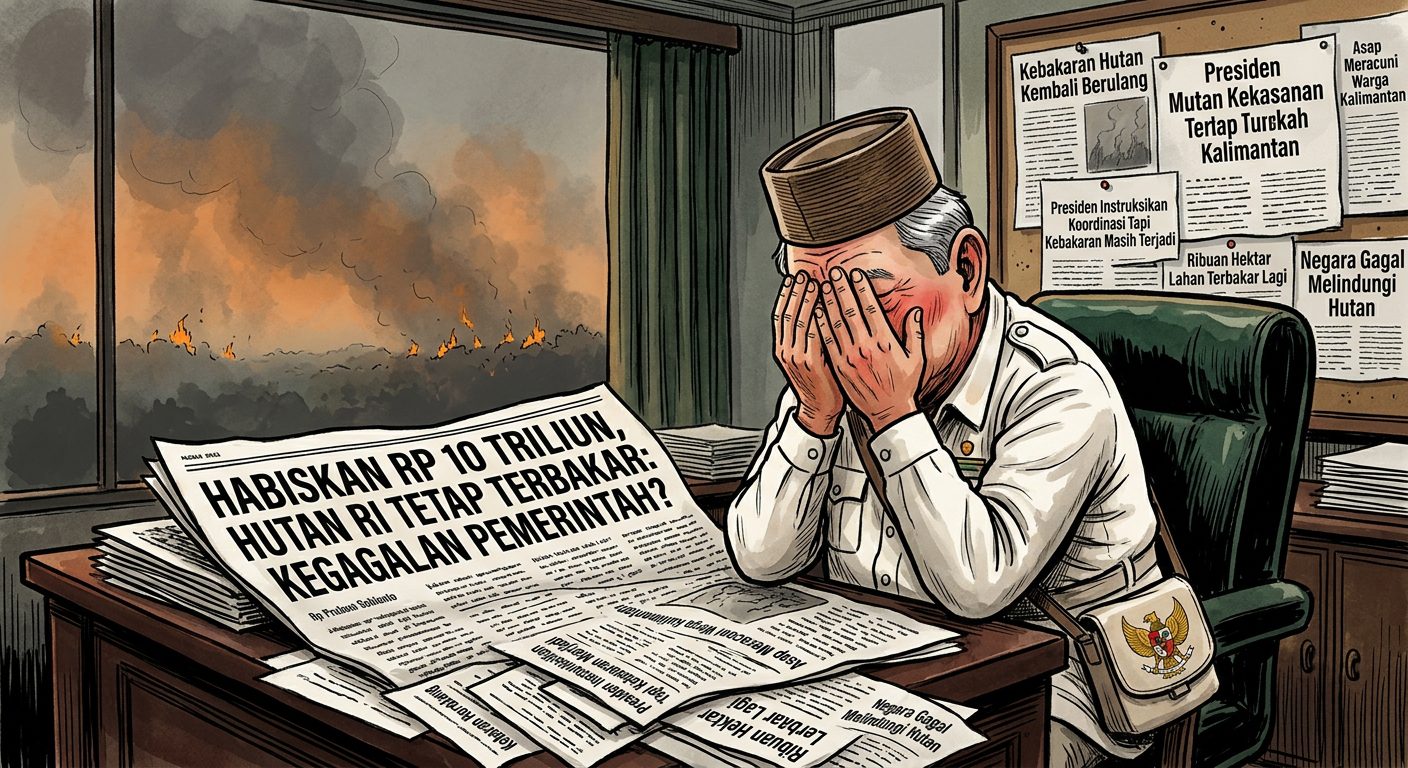

Every year, it feels like Indonesia finds itself in the same situation. Forests and land catch fire, smoke spreads across affected areas, people worry about the air they breathe, and officials announce meetings, coordination, and emergency responses.
Then, eventually, the headlines disappear.
Until it happens again.
And honestly, that is what makes Indonesia’s forest and land fires, known locally as karhutla, so frustrating. The problem itself is serious, but the feeling that we keep going through the same cycle is just as concerning.
So the question is not simply why the forests are burning. It is this: if we know this problem keeps coming back, why does it still feel like we are always trying to catch up?
This Is Bigger Than Just Another Forest Fire
The situation is not something that can be brushed aside as a few patches of dry land catching fire.
On October 12, 2026, local reporting highlighted that the burned area associated with forest and land fires in East Kalimantan had reached approximately 8,516 hectares, based on the reported incident records through October 11.
That is a staggering amount of land.
And behind numbers like these are real places, real communities, and an environment that cannot simply be restored overnight.
Forest fires are not just an environmental issue. Smoke can affect people’s daily lives, disrupt outdoor activities, and create health risks, especially for children, older people, and those with respiratory sensitivities.
For people living in affected areas, this is not an abstract discussion about climate or environmental policy. It is about whether they can go outside, work comfortably, send their children to school, and breathe without worrying about the air.
That is what often gets lost when the conversation becomes dominated by statistics and official statements.
The Government Is Taking Action, But Is It Enough?
To be fair, it would be inaccurate to say that the government has done absolutely nothing.
Government agencies have coordinated fire-control operations, and President Prabowo Subianto has reportedly instructed relevant institutions, regional governments, security forces, and other stakeholders to work together on the response.
The Ministry of Forestry has also reported changes in hotspot numbers. Its October 9 update recorded 387 high-confidence hotspots nationally as of October 8, down from 1,176 the previous day.
Those figures matter. Firefighting efforts matter, too, and the people working on the ground deserve recognition for dealing with dangerous conditions.
But here is where the bigger question begins: are we measuring success by how many meetings we hold and how many fires we put out, or by whether we can prevent the next disaster from happening?
A lower hotspot count on one day is encouraging, but it does not automatically mean the crisis is over. Hotspots are satellite-detected indications of unusual surface temperatures; they are not the same thing as confirmed fires or the total area burned.
What matters is whether the response produces lasting improvements, not just a temporary change in the daily numbers.
Why Does It Feel Like We Keep Repeating the Same Story?
Forest fires have multiple causes and contributing factors. Dry weather and peatland conditions can make fires harder to control, while land-clearing practices and human activities can also play a role.
That means there is no single switch the government can flip to solve everything.
Still, the complexity of the problem should not become an excuse for accepting the same cycle year after year.
Prevention needs to happen before smoke fills the air. High-risk areas need to be monitored, fire-prone land needs proper management, and reports of potential fires need to be acted on quickly.
There also needs to be credible enforcement when investigations establish that people or companies have violated the law.
Otherwise, we risk spending enormous amounts of effort responding to fires without addressing the conditions that allow them to keep returning.
And that is an expensive way to manage a recurring problem.
What About the People Who Have to Live With the Smoke?
This is the part that deserves much more attention.
When officials discuss forest fires, the conversation often focuses on operations, personnel, aircraft, equipment, and coordination between institutions. Those things are necessary, but the people affected by the smoke should not become an afterthought.
Residents need clear information about air quality and practical guidance on protecting themselves. Schools and local authorities need to know when conditions warrant additional precautions. Vulnerable people need access to appropriate health services.
People should not have to wait until a situation becomes a national headline before they receive useful information and support.
Environmental protection is not just about saving trees. It is also about protecting the people who live around forests and the communities that bear the consequences when something goes wrong.
If the response focuses only on extinguishing flames, we are missing an important part of the problem.
Stop Treating Prevention Like an Afterthought
Indonesia does not lack experience with forest and land fires. The country has dealt with this issue repeatedly, and that experience should be an advantage.
Authorities know which regions face recurring risks. They have access to weather forecasts, satellite monitoring, and information about vulnerable landscapes. These tools cannot prevent every fire, but they can help authorities prepare earlier and allocate resources more effectively.
That is why prevention deserves the same seriousness as emergency response.
It means preparing before the worst conditions arrive, checking vulnerable areas, improving coordination on the ground, and making sure that responsibility does not disappear between agencies or levels of government.
It also means evaluating the results honestly. If a policy is not working, it should be improved. If enforcement is inadequate, that needs to be addressed. If resources are insufficient, the public deserves a clear explanation of what is missing and what is being done about it.
Announcing a plan is easy. Showing that it actually reduces the damage is much harder.
And that is the standard people should expect.
The Public Deserves More Than Another Round of Promises
Criticizing the government does not mean ignoring the work of firefighters, local officials, volunteers, and others who are trying to control the fires. Their efforts are important, and many of them work under difficult conditions.
But recognizing their work does not mean we should stop asking questions about the broader system.
Why do some areas remain vulnerable? Are prevention efforts effective? Are those responsible for illegal burning held accountable when evidence supports it? Are affected communities receiving enough protection and information?
These are reasonable questions, not attacks on the people fighting the fires.
The government should be judged not only by its emergency response but also by its ability to reduce the likelihood and impact of future disasters.
That is what meaningful progress looks like.
So, What Needs to Change?
First, prevention needs to begin well before fire risk reaches its peak. Monitoring and early intervention should be consistent, rather than becoming urgent only after fires spread.
Second, investigations and law enforcement need to be transparent. When evidence points to illegal activity, the public should be able to see that the cases are handled seriously and fairly.
Third, public health needs to be part of the response from the beginning. People affected by smoke need timely information, practical advice, and support.
Finally, the government should communicate results, not just activities. The number of meetings held is not enough. People need to understand what has improved, what remains unresolved, and what will be done differently next time.
None of this is simple. But recurring problems require more than recurring announcements.
Indonesia Cannot Afford to Keep Learning the Same Lesson
Forest and land fires are complicated, and no honest assessment should pretend otherwise. Weather, land conditions, human activity, enforcement, and emergency response all matter.
But complexity should push us toward better preparation, not lower expectations.
When fires return year after year, people have every reason to ask whether enough is being done to prevent the next crisis.
The government may have its plans, agencies may be coordinating, and firefighters may be working around the clock. Those efforts matter. But the public also deserves to see whether they are making a lasting difference.
Because when the smoke clears, the question should not simply be whether the latest fire has been extinguished.
It should be whether Indonesia is any better prepared for the next one.
And if the same crisis keeps returning, perhaps it is time to stop asking only how quickly we can put out the fire—and start asking why we keep ending up here in the first place.